

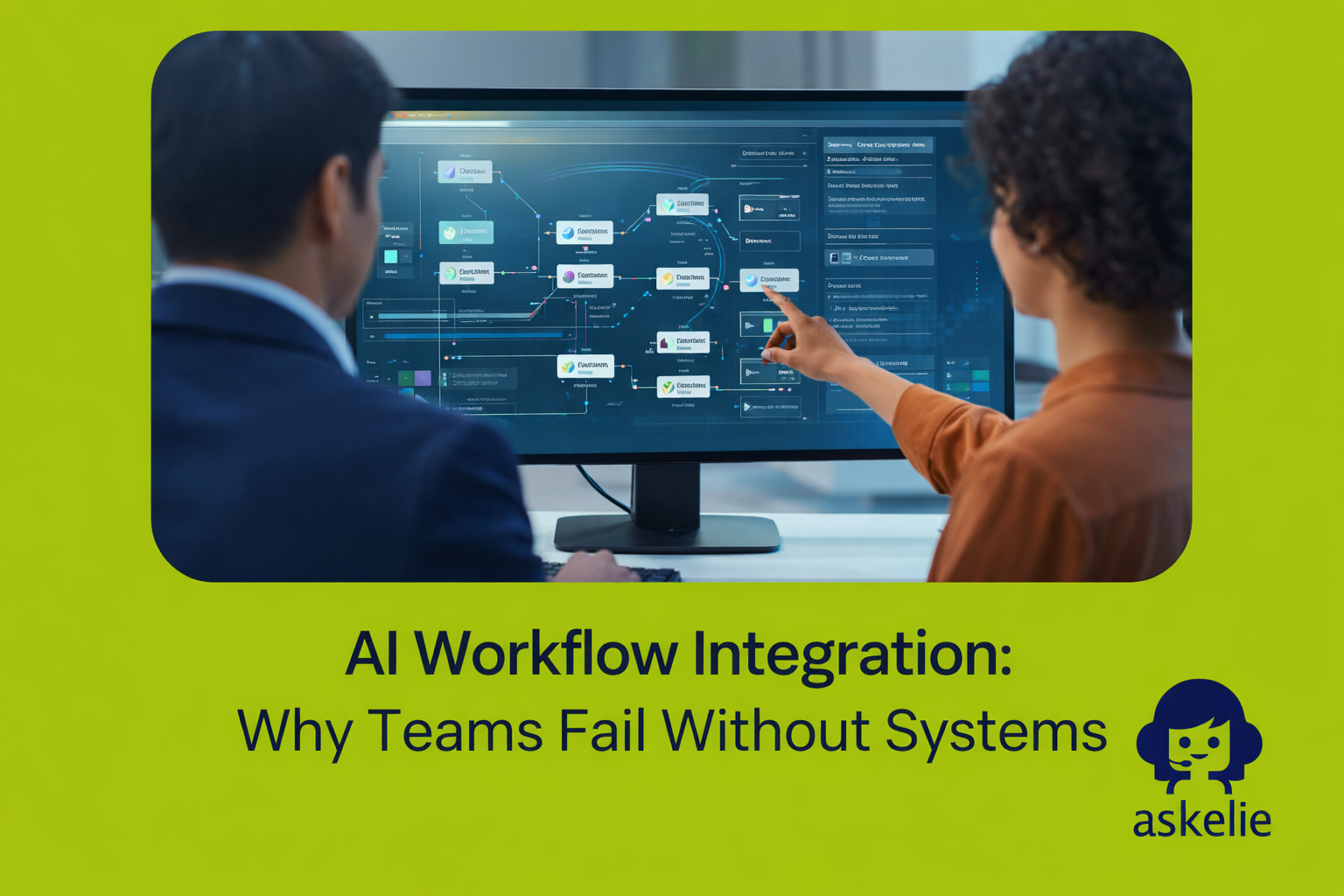
AI Workflow Integration Beyond My First 100 Days
I said the next 100 days would be about playing the music: together with our team, our customers, and the village helping us build this.
This post is what I’ve learned about AI workflow integration when you move from planning to execution.
Why Most AI Workflow Integration Efforts Sound Like Noise
For the past two years, organizations have been racing to “adopt AI.” New tools. New pilots. New promises of efficiency. Yet behind the enthusiasm, a quieter reality is emerging: most AI initiatives aren’t failing because the technology isn’t good enough. They’re failing because the systems around it aren’t ready.
What we’re seeing now isn’t an AI capability gap—it’s an organizational one. And just like a world-class orchestra playing out of sync, having the best technology doesn’t matter if the workflows aren’t designed for harmony.
The real problem isn’t AI itself. It’s context. Across industries, teams are experimenting with powerful models that can write, summarize, analyze, and generate at near-human levels. Yet productivity gains remain uneven.
Because AI is being asked to operate inside environments that were never designed for intelligence.
The Context Problem: When AI Exposes Broken Workflows
Most enterprise workflows were built for linear handoffs between people, human memory and judgment, and static documents with manual approvals. When AI enters those systems, it doesn’t transform them—it exposes their fragility.
Without shared context, clear ownership, and structured workflows, AI simply accelerates noise. It generates more content, more drafts, more versions—without improving outcomes.
This is exactly what I meant about listening first. In my first 100 days, we stood up our CRM not just to track sales, but to capture the real stories behind AI adoption—the wins, challenges, and specific use cases that actually move the needle. What we discovered is that successful AI workflow integration isn’t about the technology. It’s about understanding where your workflows are already breaking down.
The issue isn’t model quality. It’s that organizations have optimized for activity, not clarity. And AI won’t fix that. It will just make the dysfunction faster and more expensive.
From Adoption to Integration: How Work Actually Flows
The organizations seeing real returns from AI aren’t asking, “How do we get our teams to use this tool?” They’re asking something much harder: “How should work actually flow if AI is part of the team?”
That question changes everything.
Instead of bolting AI onto existing processes, forward-thinking companies are embedding it directly into the systems where decisions are made and work moves forward—CRMs, service platforms, operational workflows, internal knowledge systems.
This is what I mean by playing the music together. At AskELIE, we’re not building chatbots that generate text or single-task agents. We built a modern hyperautomation platform from the ground up—combining RPA, ML, low-code development, and workflow orchestration to deliver vertical digital workers that complete multiple tasks, understand context, and learn continuously.
The difference is subtle but profound. AI stops being something people “go to” and becomes something that works with them inside their natural workflow.
When AI operates inside the flow of work, it can understand context, anticipate needs, and reduce friction rather than add to it. That’s when productivity compounds.
Workflow Design Is the Real Battleground
The biggest unlock ahead isn’t better prompts or faster models. It’s rethinking how work itself is structured.
Most enterprise workflows were designed for a pre-AI world—linear handoffs, static documents, human-only decision loops. AI workflow integration exposes the inefficiency of those patterns almost immediately.
The teams making real progress are redesigning workflows from first principles, assuming AI is present from the start, not layered on later. They’re moving from documents to dynamic workspaces, from handoffs to shared context, and from manual reviews to exception-based oversight.
The result isn’t just speed. It’s clarity. Decisions improve because the system itself is designed to surface the right information at the right time.
This connects directly to what I learned about identity over integration. Generic AI is a race to the bottom—commoditized, price-driven, easily replicated. But when you build proprietary models that understand your domain and integrate them into workflows designed for intelligence, you create something that gets smarter with every deployment.
Don’t just plug and play with AI, because the market will plug and play with you.
The Metrics That Actually Matter for AI Workflow Integration
Here’s where playing the music requires a different kind of listening—to data, not hype.
Most companies measure AI by proxy: model accuracy, cost savings, time reduction. Those are inputs, not outcomes. What matters for genuine AI workflow integration is something I call Rate of Autonomous Value Creation (RAVC)—the percentage of business outcomes that are initiated, executed, and closed without direct human intervention.
Revenue generated. Insights surfaced. Customer actions taken. Product improvements shipped. All without someone manually pulling the levers.
For an AI-native company, that’s the metric that matters. Not how much AI you have, but how much value it creates on its own within properly designed workflows.
This is the difference between AI adoption theater and actual AI workflow integration. Adoption is about tool usage rates and pilot programs. Integration is about autonomous value creation within redesigned systems.
Playing the Music: What True Integration Looks Like
Really good live music doesn’t happen by accident. Neither does effective AI workflow integration. Both require practice, expertise, timing, and the ability to read the room and adapt in real time.
You can have the best musicians in the world, but if they’re not listening to each other, it falls apart. You can have the best AI platform in the world, but if it’s not aligned with what customers actually need and integrated into workflows that make sense, it’s just noise.
What does it look like when you get it right?
At AskELIE, we’re working with customers who are true partners in building solutions. They’re the subject matter experts who know the workflows, pain points, and business outcomes that matter. We deliver the state-of-the-art platform. Together, we create AI workflow integration that neither of us could build alone.
This is what “network as strategy” means in practice. Our customers aren’t just using our platform—they’re helping us understand where AI workflow integration creates real value versus where it’s just complexity for complexity’s sake.
The Real Inflection Point: Structure Over Speed
The next phase of AI adoption won’t be won by the companies with the most tools. It will be won by those willing to rethink how work happens at a structural level.
AI doesn’t replace teams. But it does expose which teams have designed their work to scale—and which haven’t.
In my first 100 days, I learned that speed is the wrong objective when you’re still tuning the instruments. Now, as we move into execution, I’m learning that successful AI workflow integration isn’t about moving faster—it’s about moving in sync.
The companies that win won’t necessarily be the ones that deploy the most AI. They’ll be the ones that redesign their workflows to actually support intelligence, that build proprietary understanding of their domains, and that treat their network as partners in co-creating value.
That’s where the real advantage is emerging. Not in the AI itself, but in the organizational capability to integrate it effectively.
What’s Next: The Bold Experiment
The experiment I’m most excited about? Transforming our CRM from a system of record into a system of action—a self-optimizing GTM loop that can recognize when a customer or prospect is ready for the next conversation, surface the right use case at the right time, and learn from every interaction without us having to retrain it.
That’s the promise of being AI-native. Not just using AI tools, but building systems that improve themselves.
This is playing the music. Together with our team, our customers, and the village helping us build this. We’re not racing to be first. We’re working to get it right.
Because in an AI market still thick with hype, the companies that win won’t be the ones that move fastest—they’ll be the ones that listen deepest and integrate most thoughtfully.
Comments are closed