Why Multi Vendor Tech Stacks Are Holding Organisations Back in 2025
Why Multi Vendor Tech Stacks Are Holding Organisations Back in 2025
Multi vendor tech stack complexity is holding many organisations back in 2025. Systems have been added over time to solve specific problems, but they were never designed to work together as a single, coherent whole. The result is a digital environment that is harder to manage every year and quietly drains time, money and confidence.
Most organisations did not set out to create a multi vendor tech stack. They bought what they needed at each stage of growth. A CRM to improve sales. A finance system for reporting. A case management tool for operations. A separate platform for compliance. Over time, this collection of tools turned into a maze that staff must navigate every day.
In a world where regulators, customers and staff expect faster, more accurate outcomes, this approach is no longer sustainable.
Why a multi vendor tech stack creates hidden friction
The real cost of a multi vendor tech stack is rarely obvious at first. Each system may work well on its own, but together they create friction. Staff have to copy and paste information. Teams build manual workarounds. Data becomes inconsistent. Processes break whenever something changes.
This hidden friction shows up in many ways.
Reports take longer to produce because data has to be pulled from several platforms.
Approvals stall when information is missing or conflicting.
Audits become painful because evidence is scattered across systems.
New staff struggle to learn the tools, because the process flows are not clear.
Over time, this becomes normal. People accept that work just takes longer than it should. Leaders accept that visibility will never be perfect. The organisation adapts to the limitations of its multi vendor tech stack instead of expecting better.
The risk of a multi vendor tech stack in regulated sectors
For regulated organisations, the impact is even more serious. Legal firms, education providers, financial services, healthcare organisations and public sector bodies must all maintain accurate records, clear audit trails and consistent decision making.
A fragmented multi vendor tech stack makes this difficult.
Each system holds part of the story. Access rules differ. Data formats are not aligned. Processes change in one system but not in others. Compliance teams spend their time stitching information together, instead of focusing on real risk management.
When an audit or investigation arrives, the weaknesses become visible. Missing evidence. Conflicting records. Decisions that are hard to trace. None of this is deliberate. It is a natural outcome of relying on disconnected tools that were never meant to deliver end to end governance.
Why replacing everything is not a realistic answer
When the problems of a multi vendor tech stack become clear, many leaders assume that the only answer is a full technology replacement. In practice, this is rarely realistic.
Replacing core systems is expensive, disruptive and slow. Projects often take years and carry significant risk. Staff experience change fatigue. Business as usual is affected. By the time the programme finishes, new requirements have emerged and the cycle threatens to start again.
In many cases, a full replacement simply swaps one multi vendor environment for another. The labels on the systems change, but the underlying pattern stays the same.
The real issue is not that organisations use more than one system. The real issue is that there is no intelligent layer connecting them.
How private AI can tame a multi vendor tech stack
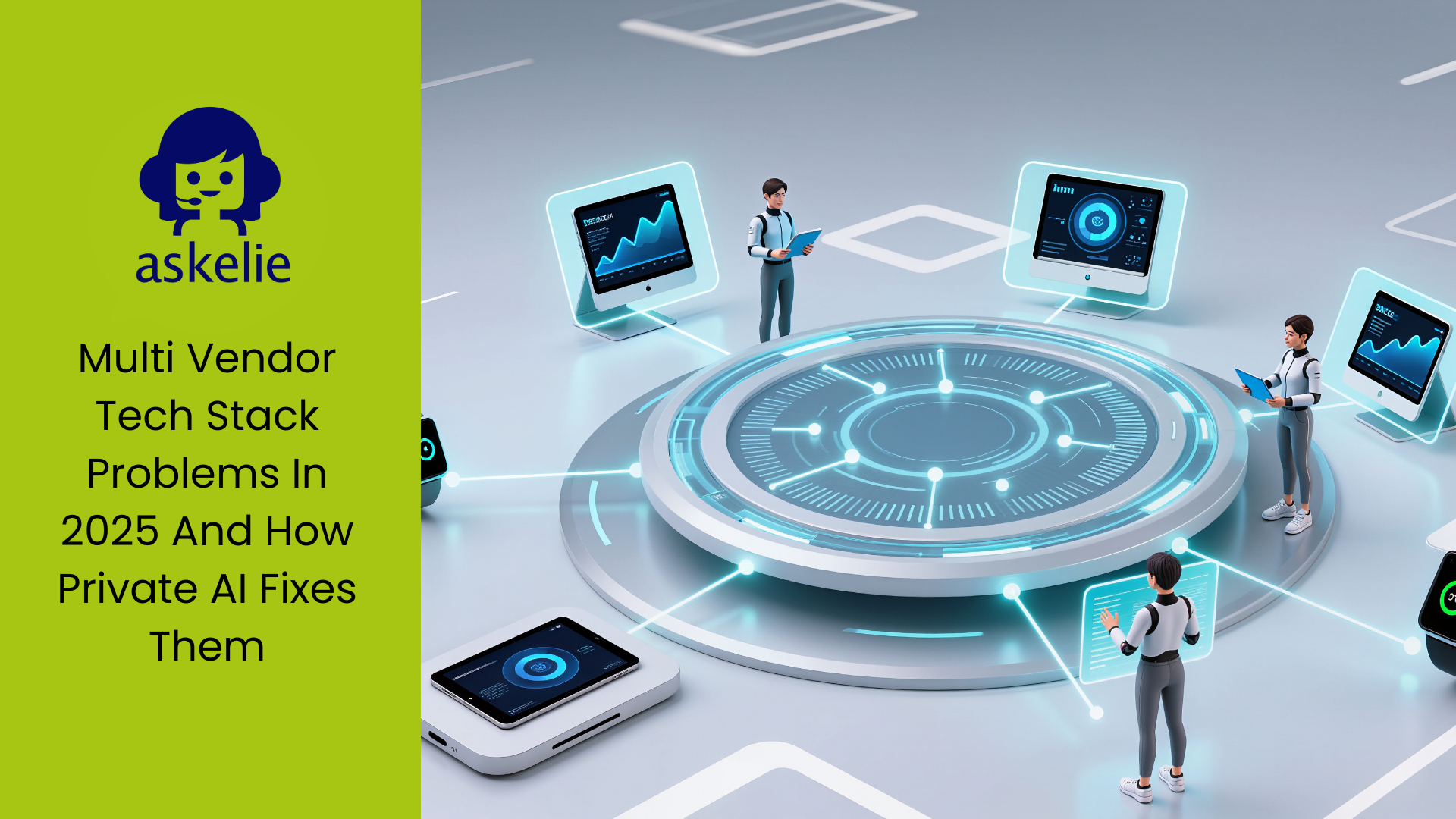
Private AI gives organisations a way to bring order to their existing estate without tearing everything out. Instead of trying to replace all systems, private AI can sit across the multi vendor tech stack, connect to the tools already in place and orchestrate work intelligently.
The Ever Learning Intelligent Engine (ELIE) from askelie® was built for exactly this reality.
ELIE Capture brings information in from different sources and standardises it.
intELIEdocs turns contracts, forms, invoices and case files into structured data that can feed any system.
ELIE Composer coordinates workflows that move across several applications, so processes feel unified even when systems are not.
AskVERA helps convert complex information into accessible content, so staff, customers and communities can understand what is happening.
All of this is delivered as private AI, which means data stays inside a controlled environment that supports regulatory requirements. There is no need to expose sensitive information to public models or lose sight of where decisions come from.
The benefits of unifying a multi vendor tech stack with private AI
Organisations that use private AI to manage their multi vendor tech stack start to see benefits quickly.
Manual rework is reduced because data only needs to be captured once.
Processes become more reliable because workflows are orchestrated centrally.
Compliance improves because information is structured, traceable and easier to audit.
Staff recover time to focus on higher value work instead of chasing systems.
Leaders gain a clear view of performance across teams and functions.
The underlying systems do not need to be perfect. What matters is that they are connected and supported by an intelligent layer that can learn, adapt and provide consistent logic.
Moving beyond the limits of a multi vendor tech stack
A multi vendor tech stack does not have to be a permanent weakness. With the right approach, it can become a stable foundation for intelligent automation and future growth.
By adopting private AI, organisations can keep the systems that already work, reduce the drag caused by manual bridging tasks and give their teams a coherent way to deliver services. The choice is no longer between expensive replacement and ongoing frustration. There is now a third path.
askelie® exists to make that path practical. By using ELIE to unify their multi vendor tech stack, organisations across legal, HR, finance, education and the public sector are regaining control of their digital operations and moving forward with confidence.