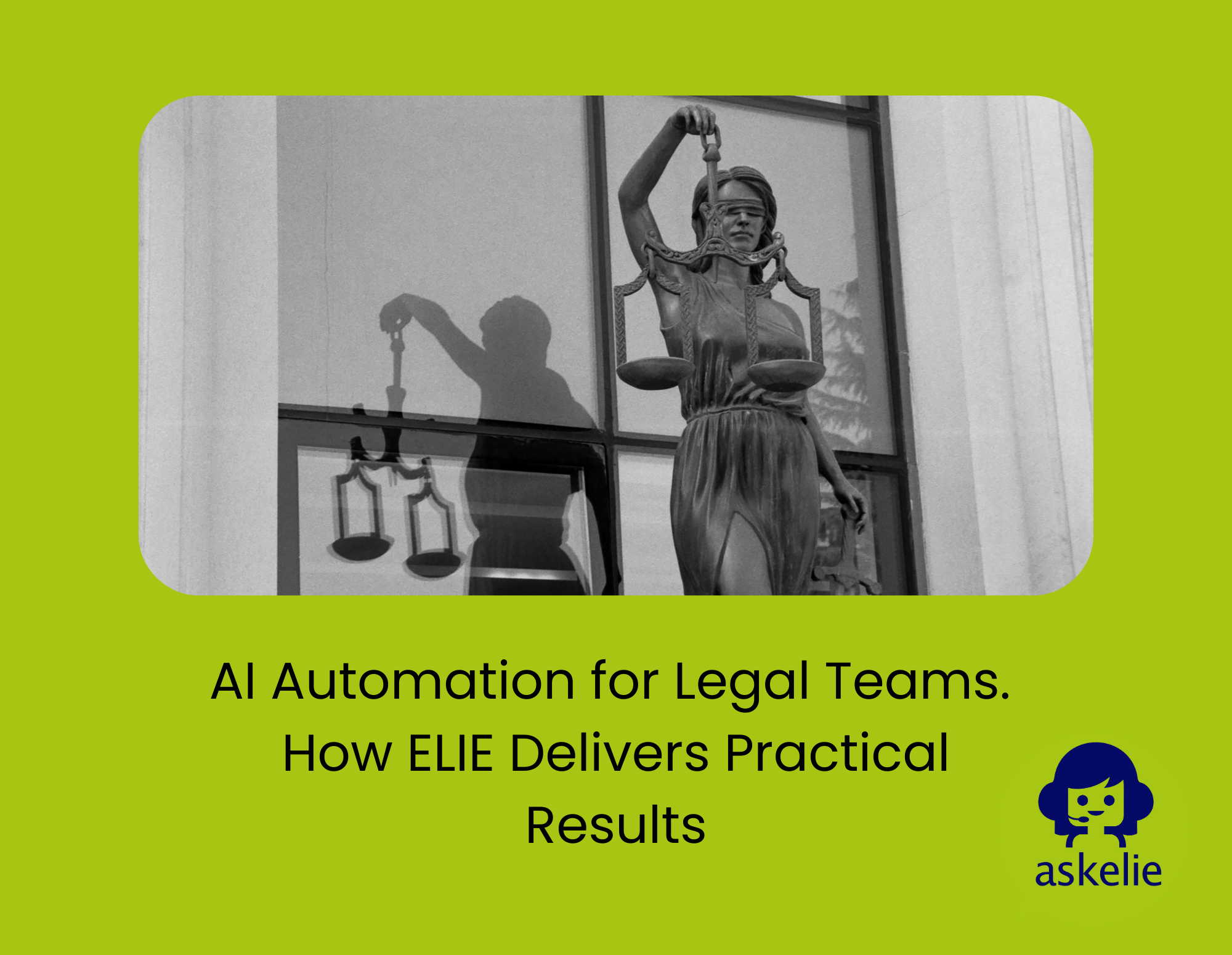
AI Automation for Legal Teams. How ELIE Delivers Practical Results
AI Automation for Legal Teams. How ELIE Delivers Practical Results
AI automation for legal teams has moved from experimentation to expectation. Legal departments across the UK are being asked to do more, move faster, and reduce risk, all while maintaining the same level of professional judgement and accountability. What has changed is not the importance of legal work, but the volume, pace, and scrutiny that now comes with it.
Legal teams are facing rising workloads driven by increased regulation, contract volumes, data protection requirements, and internal governance demands. At the same time, budgets remain tight and hiring experienced legal professionals is increasingly difficult. In this environment, AI automation for legal teams is no longer about novelty or innovation for its own sake. It is about sustainability.
Why legal teams approach AI differently
Legal work is not like other business functions. Accuracy matters more than speed. Context matters more than volume. Decisions must be explainable, defensible, and auditable. This is why many legal teams have been cautious about adopting AI, particularly tools that behave like black boxes or rely heavily on probabilistic outputs.
AI automation for legal teams must respect these realities. Legal professionals are not looking for tools that replace judgement. They need systems that support judgement by removing unnecessary administrative work, improving consistency, and reducing the risk of human error in routine tasks.
This is where many generic AI tools fall short. Chatbots trained on broad data sets may appear impressive in demos, but they struggle in real legal environments where precision, traceability, and governance are essential. Legal teams need AI that works within clearly defined boundaries.
What AI automation for legal teams actually looks like in practice
In practical terms, AI automation for legal teams focuses on repeatable, well understood activities that consume time but do not require deep legal interpretation every time they occur. These include document intake, classification, data extraction, contract review support, policy handling, and internal knowledge retrieval.
By automating these areas, legal teams can significantly reduce administrative overhead without compromising control. The goal is not to automate legal thinking, but to automate the surrounding processes that slow teams down.
For example, incoming contracts can be categorised automatically, key clauses identified, and risks flagged for review. Internal legal queries can be answered consistently using approved knowledge sources rather than ad hoc responses. Document workflows can be standardised so that nothing is missed and nothing relies on memory.
This is the kind of AI automation that delivers value quietly and reliably, without disrupting established legal practices.
Where ELIE fits into legal operations
ELIE, the Ever Learning Intelligent Engine, has been designed specifically to support controlled, auditable automation. Rather than offering a single AI capability, ELIE provides a framework for building AI driven workflows that align with how legal teams actually operate.
For AI automation for legal teams, this means legal departments can define rules, constraints, and escalation points clearly. ELIE does not operate as an unmanaged assistant. It works within boundaries set by the organisation, ensuring that outputs are consistent and reviewable.
ELIE can support legal teams by orchestrating how information flows between systems, documents, and people. This includes automating document processing, applying business rules to legal workflows, and ensuring that every step can be traced if required.
Because ELIE is designed to learn over time, it improves accuracy and relevance without changing behaviour unpredictably. This is essential for legal environments where stability matters.
Reducing risk without slowing delivery
One of the biggest concerns legal teams have about AI automation is risk. Risk of incorrect outputs, risk of data leakage, risk of decisions being challenged. These concerns are valid, particularly in regulated sectors and public services.
AI automation for legal teams must reduce risk, not introduce new sources of it. ELIE addresses this by embedding governance into automation design. Every automated process has defined inputs, controlled outputs, and clear ownership.
This allows legal teams to move faster with confidence. Automation can be scaled gradually, tested thoroughly, and expanded only when teams are comfortable. There is no requirement to hand over control to an opaque system.
In practice, this means legal teams can respond more quickly to internal requests, process higher volumes of work, and maintain consistency even as workloads increase.
Supporting collaboration across the organisation
Legal teams rarely work in isolation. They interact with procurement, finance, HR, operations, and external partners on a daily basis. One of the challenges legal departments face is managing these interactions efficiently without becoming a bottleneck.
AI automation for legal teams can help standardise how legal work is requested, reviewed, and delivered. ELIE can support structured intake processes, ensuring that requests arrive with the right information and follow the correct path.
This reduces back and forth communication and ensures that legal teams spend time on work that genuinely requires their expertise. It also improves the experience for internal stakeholders, who receive clearer responses and more predictable timelines.
Over time, this leads to stronger relationships between legal and the wider organisation, built on trust and reliability rather than friction.
Knowledge management without chaos
Legal knowledge is one of the most valuable assets an organisation has, but it is often poorly managed. Advice lives in emails, shared drives, and individual inboxes. This makes it difficult to ensure consistency and increases the risk of outdated guidance being reused.
AI automation for legal teams includes the ability to surface approved knowledge quickly and accurately. ELIE can act as a controlled knowledge layer, providing access to policies, guidance, and precedents without relying on memory or informal sharing.
Importantly, this knowledge remains governed. Legal teams decide what information is available, how it is phrased, and when it is updated. AI becomes a way to distribute knowledge reliably, not a source of unapproved advice.
Building confidence in AI adoption
Adopting AI automation is as much a cultural challenge as a technical one. Legal professionals need confidence that tools will support their work rather than undermine it. This confidence comes from transparency, predictability, and clear benefits.
By focusing on practical outcomes rather than abstract capability, AI automation for legal teams becomes easier to justify and easier to adopt. ELIE supports this approach by delivering visible improvements quickly, without requiring wholesale change.
Legal teams can start small, automate specific workflows, and expand as trust builds. This incremental approach aligns well with how legal functions manage risk and change.
Looking ahead
The role of legal teams is evolving. As organisations face greater regulatory complexity and public scrutiny, legal functions are becoming more central to decision making. To meet these expectations sustainably, legal teams need better tools, not just more people.
AI automation for legal teams is not about replacing legal professionals. It is about giving them the space to focus on what they do best. By removing administrative friction, improving consistency, and embedding governance into automation, ELIE helps legal teams operate with confidence at scale.
As AI continues to mature, the organisations that succeed will be those that adopt it thoughtfully, with clear boundaries and practical intent. For legal teams, that means automation that respects judgement, supports accountability, and delivers results that stand up to scrutiny.
That is where AI automation for legal teams becomes not just useful, but essential.